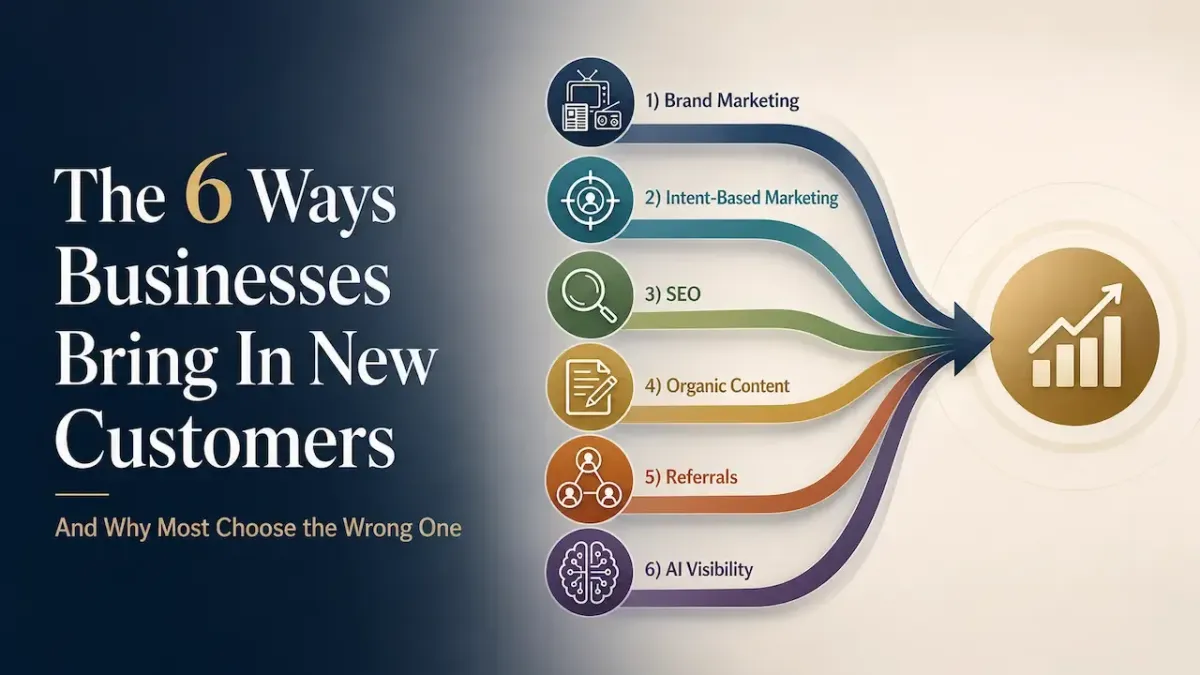
The 6 Ways Businesses Bring In New Customers — And Why Most Choose the Wrong One
Most businesses don’t struggle with marketing because they lack options.
If anything, they have too many.
Google Ads. SEO. Facebook. LinkedIn. Referrals. Networking. Radio. Print. Sponsorships. Speaking. Content. AI search. Webinars. Newsletters. Podcasts. Billboards. The list goes on.
The real problem is that many business owners don’t clearly understand what each marketing channel is actually supposed to do. So they jump from tactic to tactic, hoping one of them will finally “work,” without knowing whether they are trying to build awareness, capture demand, earn trust, generate referrals, or position themselves to be recommended by AI.
That distinction matters.
A marketing strategy that makes sense for Coca-Cola, Budweiser, or Apple may be completely wrong for a local law firm, an accounting practice, a contractor, a clinic, or a professional service business. The goal is not to “do more marketing.” The goal is to understand which type of marketing fits your business, your budget, your audience, and your stage of growth.
When you strip away all the platforms and tactics, there are really six main ways a business can bring in new customers.
1. Brand Marketing
Brand marketing is the classic “get your name out there” approach.
This includes TV, radio, print ads, billboards, sponsorships, magazine placements, event signage, and large-scale awareness campaigns. At the extreme end, you have things like Super Bowl commercials, where brands spend millions of dollars for a few seconds of attention.
The goal of brand marketing is simple: familiarity.
You want people to see your name often enough that when they eventually need what you offer, you come to mind first. That can be powerful, but it is also expensive, slow to measure, and difficult to track with precision.
This is why brand marketing tends to make the most sense for large companies with deep pockets and long time horizons. They are not always trying to generate a direct sale from a single ad. They are trying to own mental real estate in the market.
For most small and mid-sized businesses, pure brand marketing is risky. A local service business usually cannot afford to spend thousands of dollars simply hoping people remember its name later. There may be a place for sponsorships, local print, radio, or community visibility, but those efforts need to be approached with clear expectations.
Brand marketing can build recognition. But recognition alone does not always pay the bills.
2. Intent-Based Marketing
Intent-based marketing is different because it focuses on people who are already showing signs of need, interest, pain, or desire.
The easiest example is Google Ads.
If someone searches “emergency plumber near me,” “best family lawyer in Ottawa,” “dentist accepting new patients,” or “how to fix basement flooding,” they are not just casually scrolling. They are raising their hand.
That is intent.
This is what makes intent-based marketing so valuable. You are not trying to interrupt someone who has no interest in your service. You are showing up when they are already looking.
Paid social media can also fall into this category when the targeting and message are built around a specific audience with a known problem. For example, an ad targeting homeowners who want to reduce heating costs, or business owners who are struggling to generate qualified leads, is still using intent-based thinking even if the person did not type a search into Google.
The advantage of intent-based marketing is that it is usually easier to track. You can start with a smaller budget, measure clicks, calls, leads, booked appointments, and sales, then scale what works.
The downside is competition.
When everyone wants the same high-intent buyer, costs rise. And if your landing page, offer, messaging, or follow-up is weak, you can lose money quickly.
Intent-based marketing works best when the buyer already knows they have a problem and you have a clear system for turning that attention into action.
3. SEO
SEO, or Search Engine Optimization, is the organic version of intent-based marketing.
Instead of paying to show up when someone searches, you earn your place in the search results.
When a potential customer types a question, problem, or buying phrase into Google, the question becomes: does your website appear?
For years, that was one of the most valuable positions a business could earn online. And it still matters.
Organic search carries a different kind of trust. Most people understand that paid ads are paid ads. They may still click them, but they know someone paid to be there. Organic rankings feel different. When a business appears near the top of the unpaid search results, there is often an assumption that the business has earned that position.
That trust has real value.
But the search landscape is changing.
With the introduction of AI-generated answers and recommendations, the traditional value of SEO may diminish over time. In many searches now, AI-generated summaries or recommendations appear above the standard paid and organic website links. That means even if your website ranks well, your potential customer may see an AI answer before they ever see your search result.
This does not mean SEO is no longer important.
It means SEO is no longer the whole game.
A strong website still matters. Clear content still matters. Technical structure still matters. Local signals, reviews, backlinks, authority, and consistency still matter. But increasingly, those pieces do not just help you rank in Google. They also help AI engines understand who you are, what you do, where you serve, and whether you are credible enough to recommend.
In the past, SEO was mostly about earning a top position in search.
Going forward, SEO will likely become one part of a broader visibility strategy — one that includes traditional search, AI recommendations, online reputation, structured data, third-party mentions, and clear messaging.
4. Organic Content
Organic content is what most people think of when they hear “posting online.”
This includes LinkedIn posts, Facebook posts, Instagram, TikTok, YouTube, newsletters, podcasts, articles, and other content you publish without directly paying for distribution.
The appeal is obvious. You can share value, demonstrate expertise, tell stories, educate your audience, and build trust without needing a major ad budget.
But “free” is not always free.
Organic content can be extremely labour intensive. It takes time to create thoughtful content. It takes time to show up consistently. It takes time to learn what your audience responds to. And even after you do all that, your reach is still influenced by platforms and algorithms you do not control.
That does not mean organic content is a bad strategy. Far from it.
Organic content can be one of the best ways to build familiarity and authority over time. A prospect may read your posts for months before reaching out. A referral partner may quietly follow your content before deciding to introduce you. A future client may watch a video today and book a call six months from now.
The difficulty is that organic content can be hard to measure. The value is often cumulative. It may not show up as a clean return on ad spend, but it can warm up the market, support referrals, improve trust, and make every other marketing channel work better.
The key is strategy.
Posting randomly is not the same as building authority.
5. Referrals
Referrals may be the strongest form of marketing because they come with borrowed trust.
If a close friend recommends their mechanic, accountant, lawyer, dentist, or contractor, you are far more likely to trust that recommendation than a random ad. The trust has already been transferred before the business ever speaks to the prospect.
That is what makes referrals so powerful.
Referred leads often close faster, ask fewer skeptical questions, and are less price-sensitive. They arrive with a level of confidence that most other marketing channels have to work hard to create.
Referrals can come from happy clients, friends, family, professional networks, strategic partners, industry peers, community groups, or business associations. In many service businesses, referrals are the lifeblood of growth.
The downside is that referrals can be unpredictable if there is no system behind them.
Many businesses say, “Most of our business comes from referrals,” but when you ask how they generate those referrals, there is no real answer. They do good work and hope people talk.
That can work for a while, but it can also cap growth.
The strongest referral-based businesses usually combine great service with clear positioning. They make it easy for people to understand who they help, what problem they solve, and when to introduce them.
People cannot refer you clearly if they cannot explain you clearly.
6. AI Visibility, GEO, and AEO
The newest category is AI Visibility.
You may also hear it called GEO, which stands for Generative Engine Optimization, or AEO, which stands for Answer Engine Optimization.
This is what happens when someone asks ChatGPT, Perplexity, Gemini, Copilot, or another AI tool for a recommendation.
They might ask:
“Who is a good mechanic near me?”
“What are the best family lawyers in Ottawa?”
“Who helps businesses improve their visibility in AI search?”
“What is the best outdoor wedding venue near Ottawa for a DIY wedding?”
In the old search world, the goal was to rank on Google.
In the new AI search world, the goal is to be understood, trusted, and recommended by AI engines.
This is not exactly the same as SEO, although SEO is part of it. AI Visibility behaves more like a blend of search, content, reputation, technical structure, and referral trust.
AI tools are looking for signals.
They need to understand what you do, who you serve, where you serve them, what makes you different, what proof exists, what other sources say about you, and whether your online presence is consistent.
That means AI Visibility is built from several pieces: your website content, your technical structure, your schema, your reviews, your online mentions, your third-party references, your Google Business Profile, your positioning, and your overall clarity.
In some ways, AI recommendations feel like a new form of referral.
The person asking the question may not know you. They may not even know your category well. But if an AI tool presents your business as a good option, that recommendation can carry a surprising amount of trust.
Right now, that trust may be second only to a personal referral.
That creates a major opportunity for businesses that move early. It also creates a risk for businesses that are unclear online.
If your business is not well understood by AI engines, they may ignore you. Not because you are bad at what you do. Not because your competitors are necessarily better. But because the signals around your business are not strong, clear, or consistent enough for the AI to recommend you with confidence.
This is where AI Visibility becomes more than a technical exercise.
It is not just about adding schema to a website or stuffing a page with keywords. It is about making your business easier to understand, easier to trust, and easier to recommend.
So Which Marketing Channel Should You Use?
There is no universal answer, and that is exactly why so many businesses get stuck.
The right marketing channel depends on your business model, your budget, your audience, your timeline, your competition, and how much trust already exists between you and the market.
If you have a large budget and need broad awareness, brand marketing may have a role. If you need leads quickly and can track your numbers, intent-based marketing may be the best starting point. If you want long-term search visibility, SEO still matters, although its role is clearly changing as AI-generated answers and recommendations become more prominent.
If you want to build authority and trust over time, organic content can be powerful. If you already have happy clients and strong relationships, referrals may be your highest-leverage channel. And if you want your business to be found and recommended in the next era of search, AI Visibility needs to become part of your strategy.
The mistake is treating all marketing as if it works the same way.
It does not.
Some marketing is designed to create awareness. Some is designed to capture existing demand. Some builds authority over time. Some borrows trust from existing relationships. Some nurtures prospects until they are ready to buy. And now, some helps search engines and AI tools understand why your business should be recommended.
The best businesses rarely rely on one channel alone. They build a system where each channel supports the others.
Your content can support your SEO. Your SEO can support your AI Visibility. Your reviews can support your referrals.
Your referrals can strengthen your reputation. Your reputation can improve your conversion. And your message can make every channel work better.
That is the real goal.
Not simply to do more marketing, chase more platforms, or jump on every new tactic.
The goal is to build a marketing system where the right people can find you, understand you, trust you, and choose you.
© Empathic Marketing® is a registered trademark of Mike Caldwell.
All Rights Reserved.


