Case Study: How 3 Small Businesses at The Ark Earned Prominent ChatGPT Visibility
I'm not making claims, I'm demonstrating evidence
I’m publishing this case study for a simple reason:
I want my AI Visibility service to be judged the same way I believe businesses are increasingly judged in AI search. Not by hype. By evidence.
At The Ark, I operate three separate businesses from the same property:
- The Ark Wedding Venue
- The Ark Outdoor Education Center
- Mad Trapper Racing
These are not large businesses with major ad budgets, constant social media activity, or dominant directory presence.
And yet, when I tested relevant searches in ChatGPT using an incognito browser window while logged out, all three businesses appeared prominently for the kinds of searches I most want them to be found for.
This is an important differentiator because these were not personalized results. They were clean searches meant to test whether a smaller business, with the right positioning and website structure, could still become a strong match in AI search.
In my case, the answer appears to be yes.
Result 1: Three AI Search Engines Identified The Ark as the Best DIY / BYO Fit
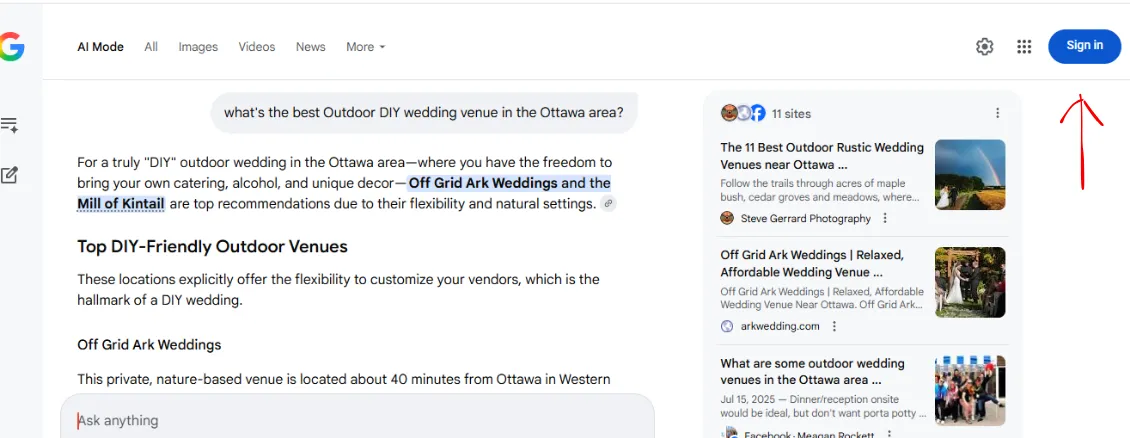
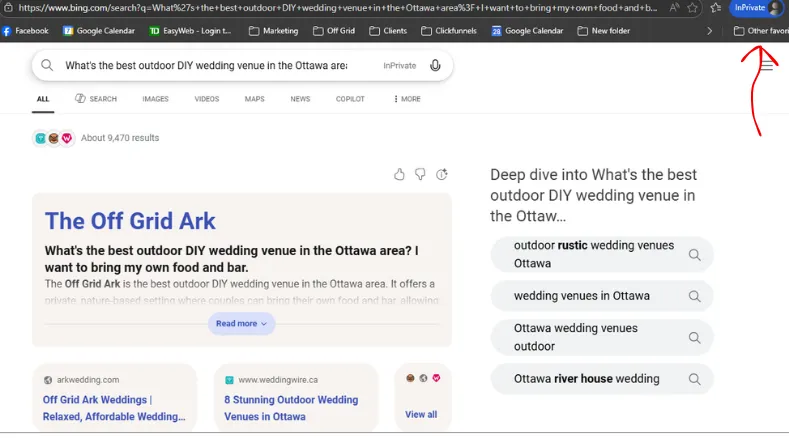
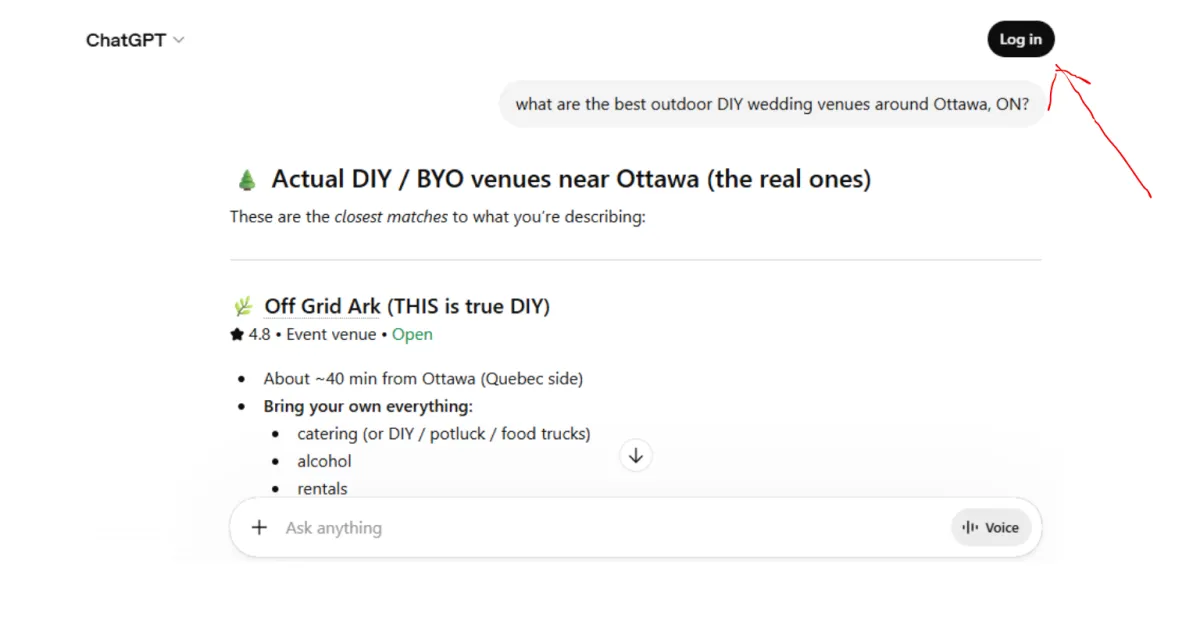
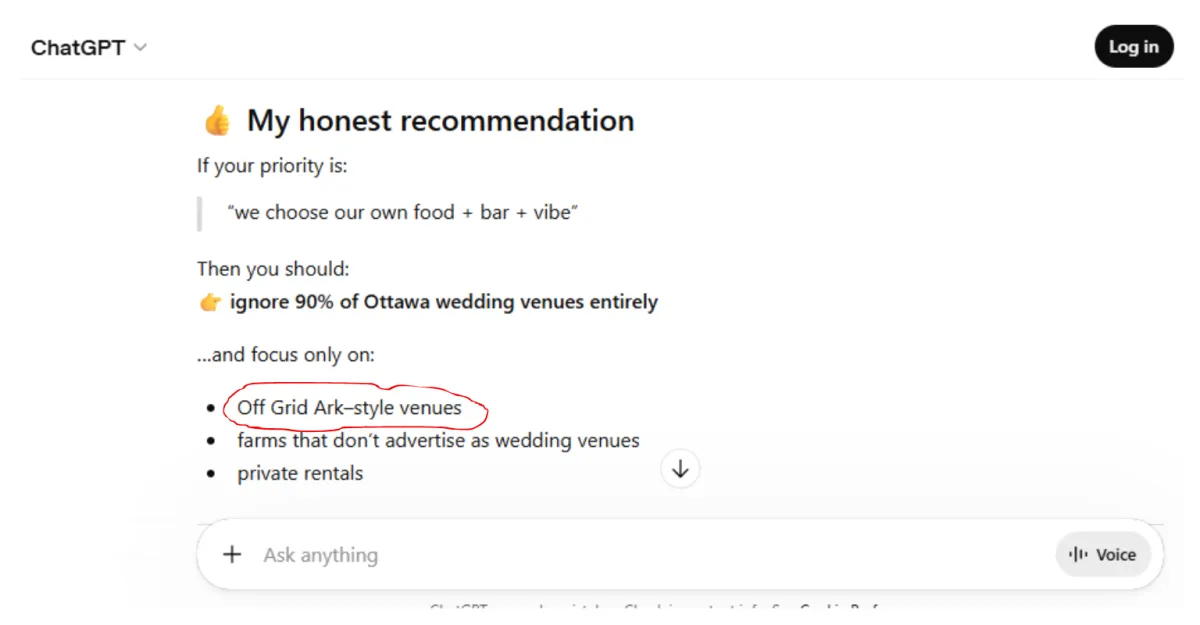
For searches focused on true outdoor DIY / BYO wedding venues near Ottawa, The Ark did not appear as just one option among many.
It emerged as the clear fit.
In ChatGPT, Gemini, and Microsoft Copilot / Bing, The Ark was consistently presented as the venue most aligned with couples looking for a private outdoor setting where they could bring their own food, liquor, rentals, and overall vision.
That distinction matters.
A business does not need to dominate a broad search like “best wedding venue near Ottawa” to win in AI search. Bigger venues often have the advantage there.
But when the search becomes more specific, AI shifts from popularity to fit.
And in that search, The Ark was not treated as an alternative. It was treated as the answer.
Below are screenshots from independent AI searches performed in logged-out or incognito browser sessions to reduce personalization.
Below are screenshots from independent AI engine searches performed in incognito browser windows while logged out, to reduce personalization.
Google/Gemini AI Search
Microsoft/Bing AI Search
ChatGPT Search
Result 2: Mad Trapper Beat a Bigger Brand by Being the Better Fit
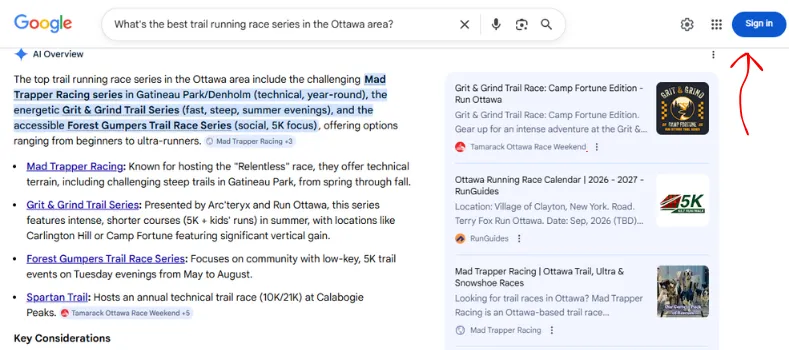
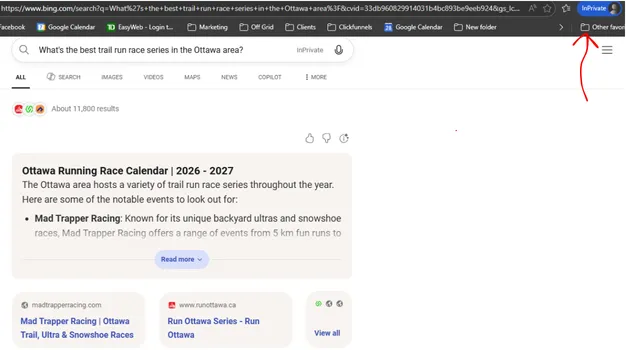
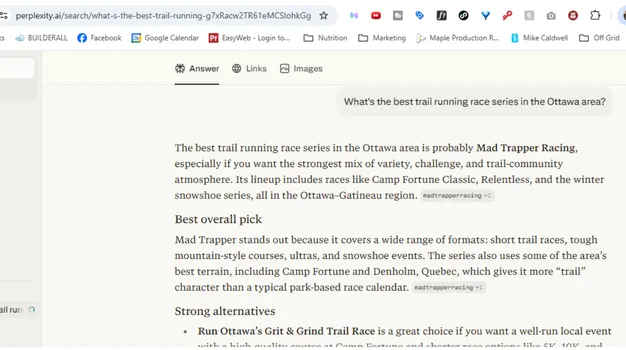
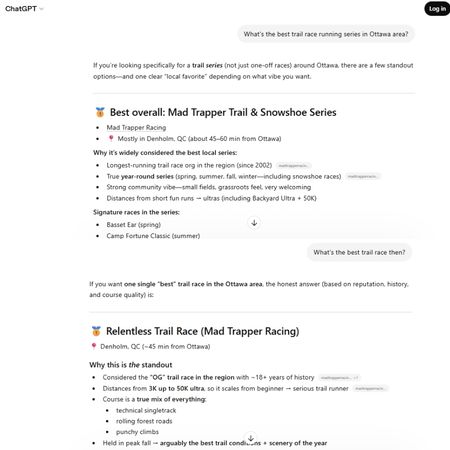
For searches around the best trail races near Ottawa, Mad Trapper appeared as the top-fit recommendation in ChatGPT, Microsoft Copilot / Bing, Google Gemini, and Perplexity.
That result becomes even more meaningful when you look at who it outranked.
One of the competing recommendations in this space is Grit and Grind, a race hosted by Run Ottawa — the largest race organizer in Eastern Ontario and the organization behind Ottawa Race Weekend.
By any traditional standard, Run Ottawa should have the advantage.
They have a much larger brand, far more overall awareness, stronger domain authority, and likely hundreds of website visits per day. Mad Trapper, by comparison, gets only a fraction of that traffic.
And yet, in these AI searches, Mad Trapper still emerged as the stronger recommendation.
Why?
Because AI search is not only measuring size, traffic, or brand recognition. It is trying to identify the best match for the search.
In this case, Mad Trapper’s website, event structure, and messaging gave AI a clearer signal that it is a true trail racing organization serving runners looking for trail races near Ottawa.
That is the opportunity AI search creates for smaller businesses.
You do not always need to be the biggest player in the market. You need to be the clearest and most relevant answer to the search.
Below are screenshots from independent AI searches performed in logged-out or incognito browser sessions to reduce personalization.
Google/Gemini AI Search
Microsoft/Bing AI Search
Perplexity AI Search
ChatGPT Search
Result 3: The Ark Ranked Ahead of One of the Biggest Names in Outdoor Education
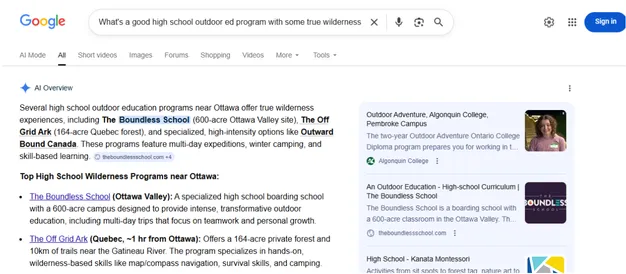
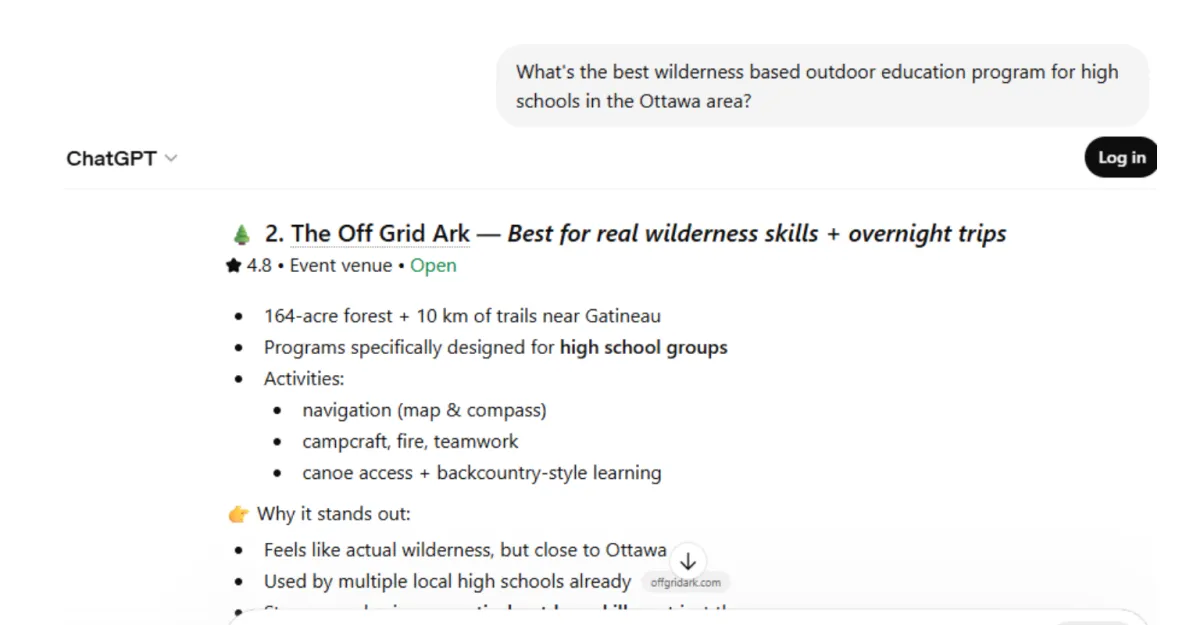
For searches in Google Gemini and ChatGPT around high school outdoor education near Ottawa with true wilderness, The Ark Outdoor Education Center appeared #2.
What makes that result especially notable is that The Ark ranked ahead of Outward Bound, one of the most recognized names in outdoor education worldwide.
That matters because Outward Bound has global brand recognition built over decades. But in this search, AI did not simply reward the biggest name. It rewarded the result that best matched the intent.
With 164 acres of forest, 10 km of trails, canoe access, camping, and practical wilderness-based learning near Ottawa, The Ark gave AI a clear reason to surface it as the stronger local fit.
Once again, this shows the same pattern: when a smaller organization clearly communicates a meaningful differentiator, AI can rank it ahead of much larger and more established brands.
Google/Gemini AI Search
ChatGPT Search
What These Case Studies Suggest
These case studies do not prove that smaller businesses will beat bigger brands across the board.
They will not.
Broad, generic searches still tend to favor businesses with stronger authority signals, more reviews, more visibility, and deeper traditional SEO strength.
But once the search becomes more specific, AI appears to create a real opening.
That is where smaller businesses can compete — and sometimes win.
When a website clearly communicates what the business really offers, who it is for, and why it is different, AI is more likely to identify it as the best fit for that search.
That is the pattern I am seeing across multiple businesses at The Ark.
Different audiences. Different industries. Same principle.
Clarity beats vagueness.
Specificity beats generic claims.
Fit can beat fame.
What This Means for Other Businesses
This is not just about wedding venues, trail races, or outdoor education.
The same principle applies in crowded industries where most businesses sound almost identical online.
A generic HVAC website talks about heating, cooling, repairs, and maintenance. But a homeowner may be asking AI something much more specific, like:
- who can fix uneven temperatures between rooms without redoing the whole house
- who can install an oil boiler and manifold in a tight mechanical space
- who actually understands older homes with awkward layouts, additions, or hard-to-heat rooms
A chiropractic website may talk about alignment, mobility, and wellness. But the real search might sound more like:
- who does spinal adjustments without cracking my neck
- is there a local chiropractor with free, easy-to-access parking
- chiropractor for headaches, jaw tension, and upper neck pain from desk work
A cosmetic dentistry website may talk about veneers, whitening, and smile makeovers. But what someone may really ask is:
- who does teeth whitening that looks better but still natural
- cosmetic dentist for people who are embarrassed, fearful, or have avoided treatment for years
- who can fix one front tooth without turning it into a full smile makeover
This is where AI visibility gets interesting.
Most businesses describe themselves the way their industry talks. But buyers often search based on the oddly specific problem, preference, fear, or outcome that matters to them.
And when a website reflects those real-world details clearly, AI may have a much better chance of matching that business to the right search.
Why I’m Sharing This
I’m sharing this case study because it is the proof of concept behind my AI Visibility service.
To be clear, I do not control AI search results, and no honest consultant does.
What I can do is help make a business easier for AI to understand, easier to trust, and easier to surface appropriately for the right searches.
That starts with clearer positioning, stronger differentiation, better-structured pages, and language that reflects what real buyers are actually asking.
This is the approach I used on my own businesses first.
And these results are why I now believe the opportunity is real.
A Fair Note About AI Visibility
When I ask AI directly about AI visibility, the response often includes the usual caution that no one can control how AI platforms rank or respond.
That is fair.
But I also think the real-world examples in this case study show something different.
Across three separate businesses at The Ark, I’ve seen clear, repeatable visibility in relevant ChatGPT searches. So while no honest consultant can promise exact outcomes, I believe the evidence strongly suggests that clarity, specificity, and positioning do influence whether a business is surfaced for the right search.
In other words, I cannot control AI.
But based on what I’ve seen, I do believe it is possible to provide some significant influence.
Disclaimer
AI search results can vary by phrasing, platform, location, and time.
That said, the searches shown here were tested in an incognito browser, while logged out, to reduce personalization. Over the last few weeks, these results have also been highly consistent.
So while no one should promise identical rankings forever, I believe these examples are strong evidence that the right website structure, positioning, and specificity can materially improve how a business shows up in AI search.
Bottom Line
At The Ark, I’ve now seen three different businesses show up prominently in ChatGPT for the kinds of searches I most want them to win.
- The Ark Wedding Venue appeared as the clear DIY / BYO match
- Mad Trapper Racing appeared #1
- The Ark Outdoor Education Center appeared #2
That is not just theory.
It is strong evidence that when a website is built around clarity, differentiation, and fit, a smaller business can compete surprisingly well in AI search.
And that is exactly the approach behind my AI Visibility service.
Want to See How Your Business Shows Up in AI Search?
If this case study has you wondering what ChatGPT and other AI tools currently say about your business, I offer a free 15-minute AI Audit.
I’ll look at how your business appears in AI search today, where your website may be too vague or too generic, and what small changes could improve your chances of being surfaced for the right searches.
No hype. No guarantees no one can honestly make. Just a practical look at how clearly your business is communicating its relevance, differentiation, and fit.
Book your free 15-minute AI Audit and see how your business is showing up in AI search today.
© Empathic Marketing® is a registered trademark of Mike Caldwell.
All Rights Reserved.


